Linux Cluster Concept [Fail-Over and Load-Balancing Cluster]
e_ezylinux··3 min read
Linux Cluster style
High Availability or Fail-Over Cluster
Load balancing Cluster
Linux Cluster: High Availibility (HA) or Fail-Over Cluster
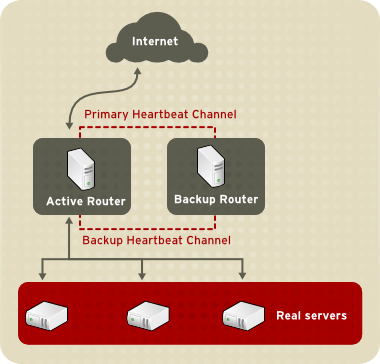
Failover means that when the primary server goes down, the secondary server takes over. In the diagram, these are the Linux directors. Suppose the server in the middle on the left is server A and the one on the right is server B. The real servers below them provide the services for which we want to avoid downtime. Configure servers A and B for HA, with A as the primary and B as the secondary. They share a virtual IP address that acts as the common address for both servers.
For example, consider a web server. In the diagram, the virtual IP address 192.168.1.1/24 is in use by server A, the primary server, which also runs the web server service.
Server B, the secondary, checks whether server A is down. If A goes down, B takes over as the primary, uses 192.168.1.1/24, and starts the web server service.
When server A comes back up, we can configure it either to become the primary again or to wait until server B goes down before taking over.
One use is a failover MySQL server. (Because MySQL does not support SAN/NAS operation, use MySQL Cluster if you need a full cluster.)
Software: RedHat Cluster Suite, Linux High Availability
Linux Cluster: Load balancing Cluster
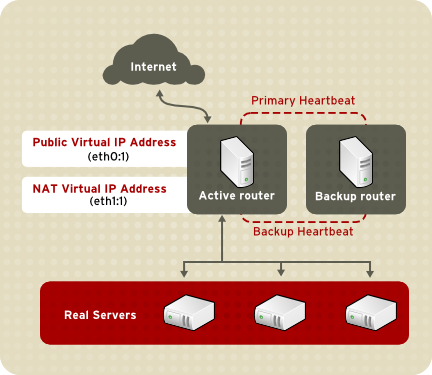
The servers share the work, regardless of their platforms, because linux cluster manages it. See the diagram.
The primary server has four IP addresses: two interface addresses and two virtual addresses.
The principle is similar to failover. Suppose the primary is server A, with IP addresses 192.168.1.1, 192.168.1.2, 10.1.1.2, and 10.1.1.1. It opens the ports used by the services on the real servers and forwards requests to them. More than one real server may provide the same service. For example, with two web servers and about 10 incoming connections, server A can forward five connections to each real web server, depending on the configuration. Server B checks whether A is down and takes over as the primary if it is.
One use is a web server for a busy website whose workload exceeds what one machine can handle.
Software: RedHat Cluster Suite, Linux Virtual Server
When running packstack to install OpenStack, the following error may appear: [root@openstack-liberty1 ~]# packstack --answer-file=answers.txt ERROR:root:Failed to load plugin from file prescript_000.py
If VMs cannot ping their gateway or router after creating a network and router in OpenStack, check the VLAN tags in Open vSwitch on the compute and network nodes.
If cloud-config on an AWS EC2 instance or OpenStack does not behave as configured, and the error log shows Failed at merging in cloud config part from ... as below…
 For example, consider a web server. In the diagram, the virtual IP address 192.168.1.1/24 is in use by server A, the primary server, which also runs the web server service.
Server B, the secondary, checks whether server A is down. If A goes down, B takes over as the primary, uses 192.168.1.1/24, and starts the web server service.
When server A comes back up, we can configure it either to become the primary again or to wait until server B goes down before taking over.
One use is a failover MySQL server. (Because MySQL does not support SAN/NAS operation, use MySQL Cluster if you need a full cluster.)
Software: RedHat Cluster Suite, Linux High Availability
 The primary server has four IP addresses: two interface addresses and two virtual addresses.
The principle is similar to failover. Suppose the primary is server A, with IP addresses 192.168.1.1, 192.168.1.2, 10.1.1.2, and 10.1.1.1. It opens the ports used by the services on the real servers and forwards requests to them. More than one real server may provide the same service. For example, with two web servers and about 10 incoming connections, server A can forward five connections to each real web server, depending on the configuration. Server B checks whether A is down and takes over as the primary if it is.
One use is a web server for a busy website whose workload exceeds what one machine can handle.
Software: RedHat Cluster Suite, Linux Virtual Server