Red Hat Enterprise Virtualization [RHEV]
Virtualization technology is now widely used. One of its most common applications is VPS, or Virtual Private Server, hosting. Many virtualization products are available, including MS Virtual PC, VMware, Parallel (MacOSX), and VirtualBox. Linux also has several virtualization solutions, such as Xen and KVM.
This article gives a brief overview of the architecture of Red Hat Enterprise Virtualization, a virtual machine solution that uses KVM as its core.
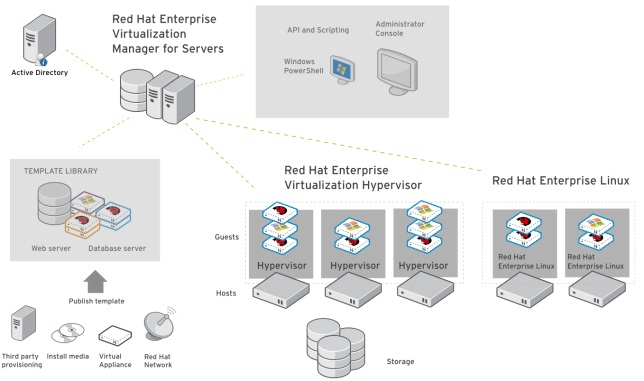 As the diagram shows, Red Hat Enterprise Virtualization, or RHEV, has four main components:
-
Red Hat Enterprise Virtualization Manager for Server ( RHEV-M ) runs Red Hat Virtualization Manager on Windows 2003, using the following services:
- Admin portal: GUI สำหรับการจัดการ RHEV - User portal: เป็น web portal สำหรับให้ผู้ใช้งานที่ไม่ได้เป็น admin เข้าไปใช้งาน virtual workstations - SQL Server: ใช้สำหรับเก็บข้อมูลต่างๆรวมทั้ง log ของ RHEV -
Red Hat Enterprise Virtualization Hypervisor ( RHEV-H ) acts as the virtual host (the CPU must support Intel VT/AMD-V), running on Red Hat Linux with KVM.
-
Storage primarily holds VM hard drive images and supports NFS exports, iSCSI targets, and FC LUNs.
-
Administrator PC is the computer used by the RHEV administrator to administer and manage RHEV through RHEV-M.
These are only the basic details of the architecture of Red Hat Enterprise Virtualization [RHEV]. Thanks to Red Hat
English reading note: In the preserved RHEV-M service list, Admin portal is the GUI for managing RHEV; User portal is the web portal through which non-admin users access virtual workstations; SQL Server stores RHEV data, including logs.