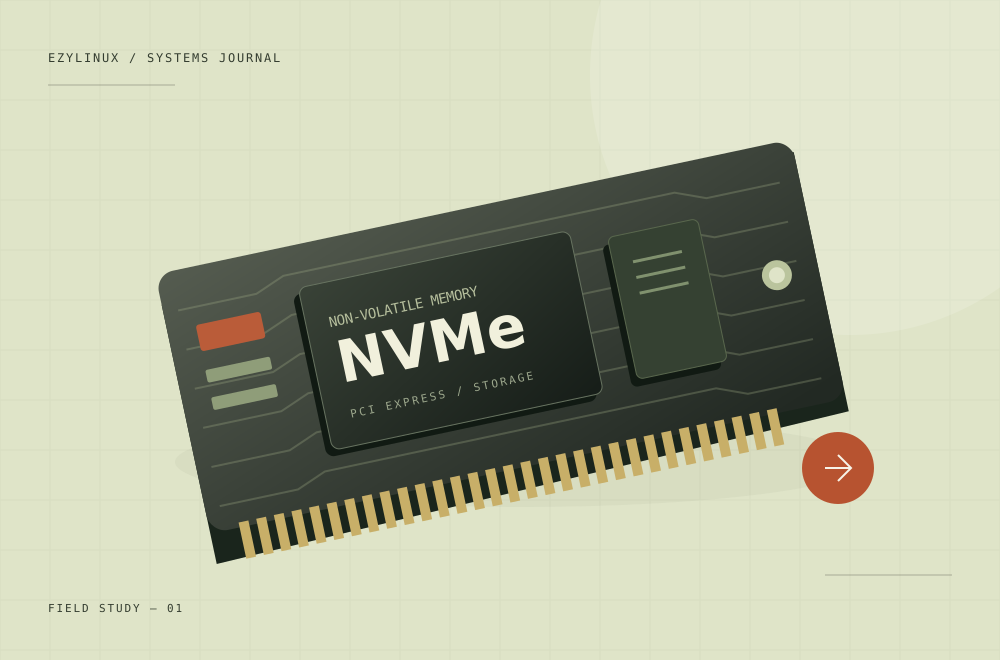
How to install Raspberry Pi OS to NVMe storage by rpi-imager cli
A new case let me add NVMe M.2 storage to my Raspberry Pi. Here is how I installed Raspberry Pi OS using rpi-imager from console mode.
24 articles on this topic
A new case let me add NVMe M.2 storage to my Raspberry Pi. Here is how I installed Raspberry Pi OS using rpi-imager from console mode.
After adding a hotplug-capable HDD to Linux, whether on a VM or physical machine, # fdisk -l may not show it until reboot. Rescanning SCSI can detect it without rebooting.
Newer Linux versions use UUIDs to identify hard disks instead of device names. This prevents the system from using the wrong disk when there is more than one and a disk fails or is removed…
Disks larger than 2 TB require a GPT-capable partitioning tool. gdisk works much like fdisk and supports large disks and up to 128 partitions.
When reusing a removed GlusterFS brick, adding it may fail with /path/app or a prefix of it is already part of a volume. Here is how to resolve it.
After writing about mounting NTFS on CentOS / RHEL, I wanted to share how Linux can format a hard disk with an NTFS filesystem without using Windows.
NTFS is a Windows filesystem. ntfs-3g, led by Szabolcs Szakacsits, provides read/write support without recompiling, including a free community edition.
There are four I/O schedulers for hard disks and block devices: anticipatory, noop, deadline, and CFQ. CFQ is usually the default. To change the I/O scheduler…
smartd monitors hard disks using SMART, or Self-Monitoring, Analysis, and Reporting Technology, to analyze, check, report status, and predict whether a hard disk…
To rescan an entire SCSI bus and re-register all devices found: rescan SCSI so the system sees a new device. On some Linux systems, this also adds or removes devices.
The new autofs version (autofs5) adds features that improve interoperability with other systems. The new features include: Direct map support, which provides a mechanism to automatica…
Linux stores device files in /dev/, with names depending on device type. This article explains how to identify hard drive names and their prefixes.
Adding a hard disk to Linux is simpler than some people think, though slightly harder than in Microsoft Windows. You need to understand partitioning, filesystems, and mounting.
Red Hat Enterprise Linux 4.5 and later have a feature for implementing highly available LVM without CLVM, which is part of GFS.
A major difference between NFS v4 and earlier versions is the ability to export a single directory in a way similar to an FTP or web server, such as exporting /shared.
Resolve LVM error VG meta data inconsistent by booting into rescue mode, restoring VG metadata, rescanning devices and groups, and activating the volume group.
To reduce RAID 1 rebuild time, use: # mdadm -C /dev/md0 -l1 -n2 /dev/sda1 /dev/sda2 --bitmap=internal. --bitmap (Write-intent bitmap) reduces synchronization time…
Growing Linux software RAID is straightforward. This example adds /dev/sdd1 to a three-disk RAID 5 array at /dev/md0, then grows the array and filesystem.
This example reduces a 10 GB LVM volume to 8 GB, assuming it is mounted at /data, by shrinking the filesystem before reducing the logical volume.
Linux normally mounts USB flash drives or thumb drives automatically when you plug them in. Sometimes it does not, which can frustrate new users…
CentOS/RHEL 5 supports filesystems up to 8 TB, with 16 TB planned for the future. In practice, filesystem creation may stop at 2 TB; this article gives a workaround.
Linux supports online SCSI rescans, allowing drives to be rescanned without restarting the system.
This is an older article brought up to date because some readers may not know what device-mapper multipathing is for. It provides multipathing for storage devices such as SAN or NAS…
To add a new SWAP partition, you need an unused partition with its type set to Linux-SWAP. For example, suppose /dev/hdb3 is unused. Steps to create SWAP…